Keeping bulk water out while letting wall assemblies dry
Exterior wall waterproofing on above-grade facades is not about wrapping a building in a plastic bag. In a freeze-thaw climate like the Capital Region, successful moisture control does two jobs at once: it turns bulk rainwater and snowmelt away at every roof edge, sill, trim projection and movement joint, while still allowing incidental moisture inside masonry or stucco walls to dry safely without blistering the finish. At 518 Stucco, our waterproofing work focuses on above-grade building envelopes, not basement foundation excavation or interior sump systems, serving homes and commercial buildings in Troy, Cohoes, Watervliet, Schenectady, Saratoga Springs, Clifton Park and across the 518.
Perimeter sealant replacement with closed-cell backer rod
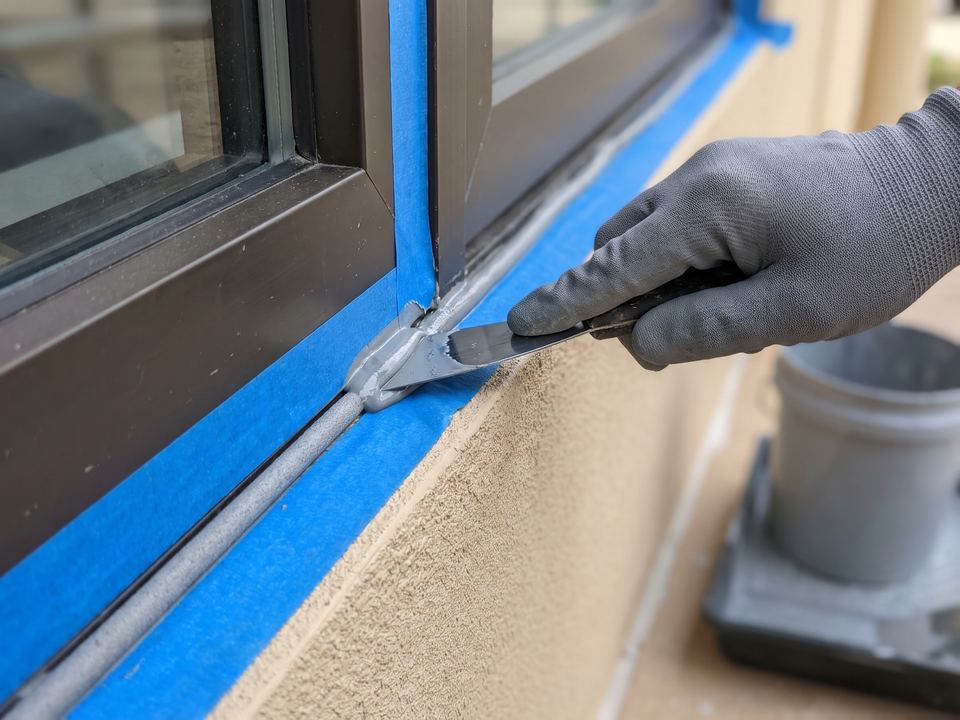
Most facade leaks start within an inch of a window frame, door jamb, louver, control joint or dissimilar-material transition where stucco meets brick, stone, wood trim or aluminum panels. Hardware-store caulk smeared over top of old, cracked sealant rarely survives a single winter because it bonds to three surfaces at once and tears as soon as the frame expands or contracts.
Our crews cut out brittle, split sealant cleanly down to sound substrates, clean and prime joint faces where required by the substrate, press closed-cell foam backer rod to the proper depth, and tool high-movement polyurethane, hybrid or low-modulus silicone sealant into an hourglass profile. Bonding only to the two opposing joint walls lets the joint stretch and compress cleanly through summer heat and January cold without pulling loose from porous stucco or masonry.
Sealant alone cannot replace missing gravity flashing. Where a sloped roof dies into a taller stucco or EIFS elevation, step flashing needs a turned kick-out diverter at the eave to throw runoff into the gutter instead of behind the cladding. Horizontal trim bands, stone water tables, window heads and masonry sills likewise need sloped drip caps and head flashings with end dams so water drips clear of the wall below. On a 2026 residential band repair in Schenectady, adding a new metal drip cap over the rebuilt EIFS projection stopped the recurring wash that caused the failure in the first place.
When walls are opened for new three-coat stucco, drainage EIFS, stone veneer or metal panels, we also install continuous sheet or fluid-applied air and water barriers across the sheathing, detailing rough openings, sill pans and transitions before any lath or insulation goes up.
Breathable coatings for older masonry stucco versus elastomeric finishes
Coating selection depends heavily on what sits behind the stucco. Older brick rowhouses and historic homes in Troy, Cohoes, Watervliet, Schenectady and Saratoga Springs with lime-based plaster or older cement stucco directly over masonry need vapor-permeable mineral silicate or breathable masonry coatings. Those finishes shed wind-driven rain while letting water vapor pass outward, preventing the trapped-ice spalling caused by non-breathable house paints.
On modern framed stucco walls, block structures and EIFS elevations where bridging hairline surface crazing is the goal, high-build elastomeric or acrylic coatings provide flexible weather protection and uniform color, paired with stucco refinishing where texture repairs come first. Coatings and most wet-applied barrier materials need dry surfaces and temperatures around 40 °F and rising with no freezing for 24 hours; call or text (518) 888-7851 any time of year for a photo review and estimate.